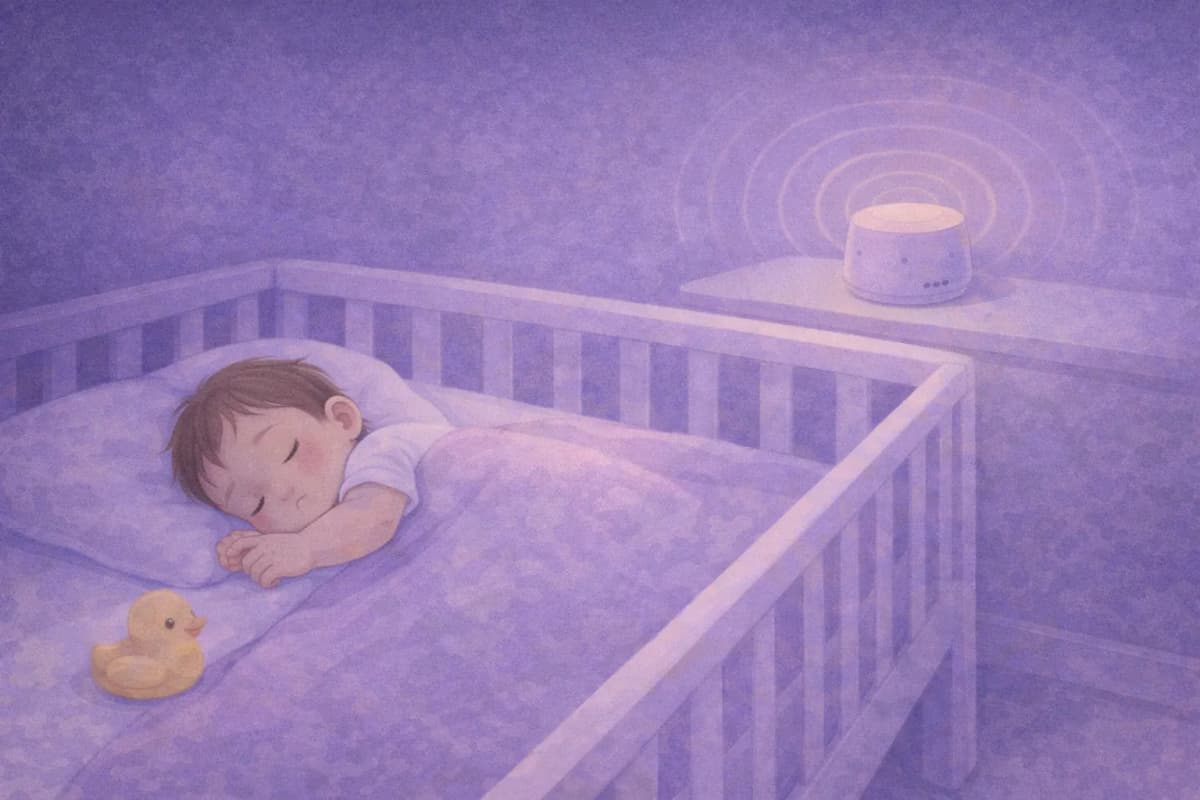
White noise has become one of the most recommended tools for improving baby sleep. But with conflicting advice online, many parents wonder: is it actually safe? And does it really work?
The evidence is more limited than many summaries imply. White noise may help some newborns settle, but output can be too loud when a device is close or set high. Here is what the cited studies actually tested.
What the Research Says
A 1990 randomized trial studied 40 newborns aged 2–7 days. Sixteen of 20 exposed to white noise fell asleep within five minutes, compared with 5 of 20 controls. That small, short study suggests a possible settling effect in newborns; it does not establish longer sleep, fewer night wakings, effectiveness in older babies, or an ideal sound level.
One practical explanation is sound masking: a steady background can make abrupt household noises less noticeable. The trial did not determine a biological mechanism.
Evidence across sound types, ages, devices, and outcomes is not strong enough to promise faster sleep onset or fewer wakings for every baby.
White Noise vs. Pink Noise vs. Brown Noise
Not all "noise" is the same. Here's what parents should know:
| Type | Sound Profile | Best For |
|---|---|---|
| White noise | Equal intensity across all frequencies. Sounds like static, a fan, or TV snow | Masking sudden household sounds (dogs barking, doors closing, siblings) |
| Pink noise | Emphasizes lower frequencies. Sounds like steady rain, wind through trees, or a waterfall | Calming babies who are sensitive to higher-pitched sounds |
| Brown noise | Even deeper, lower frequencies. Sounds like a low rumble, distant thunder, or heavy rain | Creating a very deep, enveloping sound environment |
Pink noise often sounds softer because it emphasizes lower frequencies, but adult sleep studies should not be treated as proof of an infant benefit. Infant-specific comparative evidence remains limited.
SleepSpot includes both white noise and pink noise in its built-in sound library, along with nature sounds and lullabies. You can set a sleep timer so the sound automatically stops after your baby falls asleep, or keep it playing through the night.
Conservative Safety Practices
Sound output varies substantially by device, volume setting, room, and distance. The practices below are conservative precautions, not a claim that one setting is universally safe.
Volume: Use the Lowest Useful Setting
A 2014 study in Pediatrics tested 14 infant sleep machines at maximum volume. All exceeded 50 dBA at 30 cm, and three exceeded 85 dBA at that distance. The authors concluded that these devices can produce levels that may damage infant hearing and recommended safer operation.
Measure at the baby's sleep position, use the lowest setting that serves the masking purpose, and remember that a phone meter is a practical estimate rather than a calibrated clinical instrument.
Distance: Keep the Source Well Outside the Crib
Never place a phone or sound machine inside or attached to the crib. Greater distance generally lowers the level at the baby's ears and also keeps the device, cord, and accessories out of the sleep space.
Duration: Not Continuously 24/7
Use white noise during sleep periods — naps and nighttime — but not as a constant background throughout the entire day. Babies need exposure to normal environmental sounds during wake time for healthy auditory development and language acquisition.
How to Use White Noise Effectively
For Newborns (0-3 Months)
Newborns respond most strongly to white noise because they recently left the loud womb environment. Use it:
- During all sleep periods (naps and night)
- At a moderate volume that's audible but not overpowering
- Start before you put baby down, so the sound is part of the sleep environment
- Use a consistent sound type — switching between sounds every night can be confusing
For Older Babies (4-12 Months)
By 4 months, white noise shifts from mimicking the womb to serving as a sleep cue. It signals to your baby's brain: "this sound means it's time to sleep." Use it:
- As part of the bedtime routine — turn it on during the last few steps
- During nap transitions — white noise can help when dropping from 3 naps to 2
- To mask disruptions — especially useful if you have older children, pets, or a noisy environment
For Toddlers (12-24 Months)
Toddlers benefit from white noise primarily for its masking effect and as a consistent sleep association:
- During the 18-month sleep regression (similar to the 4-month regression), when toddlers resist sleep, keeping the sound environment consistent provides comfort
- For early morning waking — white noise can prevent birds, traffic, or sunrise from waking your toddler too early
Common White Noise Mistakes
Playing It Too Loud
Avoid maximum volume. Louder output is not proven to improve infant sleep and can increase hearing risk, especially when the source is close.
Using a Phone or Tablet
Phone speakers can distort at higher volumes, play inconsistently, and drain battery. More importantly, phones emit blue light and receive notifications. Use a dedicated sound machine or an app designed for baby sleep like SleepSpot, which can play sounds with the screen off and includes an auto-shutoff timer.
Starting After Baby is Already Upset
White noise works best as a preventive measure, not a rescue tool. Turn it on before putting your baby down — ideally as part of the bedtime routine — rather than waiting until they're already crying.
Stopping Cold Turkey
If you've been using white noise consistently and want to stop, don't turn it off suddenly. Gradually reduce the volume by about 10-15% every few nights over 1-2 weeks. This gives your baby time to adjust.
Built-in Sounds in SleepSpot
SleepSpot's lullabies and sound feature includes:
- White noise — classic static/fan sound
- Pink noise — softer, rain-like sound
- Nature sounds — rain, ocean waves, forest
- Lullabies — gentle melodies for winding down
- Auto-shutoff timer — set sounds to stop after 15, 30, 45, or 60 minutes
- Background play — sounds continue even when the screen is locked
The advantage of using SleepSpot for sounds instead of a separate machine is that your sleep tracking and sound playback are in one app. When you start a sleep session, you can simultaneously start white noise — and the app logs the correlation between sound use and sleep quality over time.
Use White Noise Conservatively
White noise may help mask sudden sounds or help some newborns settle, but the evidence is limited. Use the lowest useful volume, keep the source well outside the crib, measure at the sleep position, and follow manufacturer and pediatric guidance.
If you try it, observe how your baby responds and stop if it appears disruptive. Do not treat white noise as a substitute for safe-sleep practices or medical advice.
“White noise may mask sudden environmental sounds, but evidence for infant sleep is limited and safe volume and placement matter.”
— SleepSpot Editorial Team