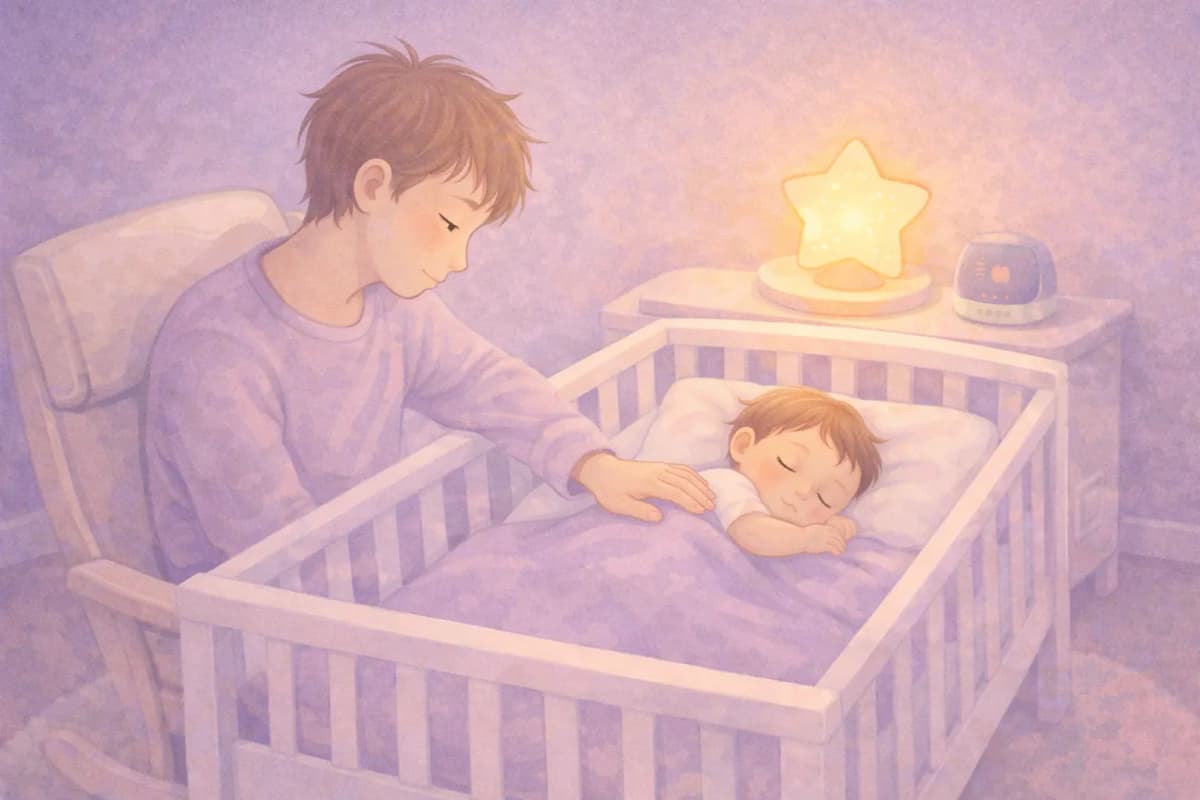
What Are Sleep Associations?
Every person — adult or baby — has sleep associations. They are the conditions present when you fall asleep that your brain links to the act of sleeping itself. For adults, this might be a dark room, a certain pillow, or the hum of a fan. For babies, these associations are often formed around caregiving: being nursed, rocked, bounced, or held.
Sleep alternates between stages, and brief arousals can occur. How fully a baby wakes and what helps them resettle varies by age, feeding needs, development, illness, environment, and learned routines; it should not be reduced to one universal mechanism.
If your baby fell asleep nursing, they will wake between sleep cycles looking for the breast. If they fell asleep in your arms, they will startle when they find themselves alone in a crib. This is not manipulation or a character flaw — it is simple neuroscience. Understanding this is the first step toward changing it.
Positive vs. Negative Sleep Associations
Not all sleep associations are created equal. Sleep specialists typically divide them into two categories:
Positive sleep associations are cues that signal sleep is coming and can be present throughout the night without requiring caregiver intervention. These include:
- A consistent, darkened sleep environment
- White noise or a sound machine (see our guide on white noise for baby sleep)
- A sleep sack or swaddle (age-appropriate)
- A lovey or comfort object (for babies over 12 months)
- A predictable bedtime routine
Negative sleep associations are those that require an adult's active participation to recreate at each waking. Common examples include:
- Nursing or bottle-feeding to sleep
- Rocking or bouncing to full sleep
- Being held or worn until asleep
- Pacifier use when a baby cannot replace it independently
- Motion (car rides, stroller naps)
It is worth noting that "negative" does not mean harmful. These associations are developmentally normal and serve important bonding and nutritional functions — especially in the early months. The term simply reflects that they can lead to fragmented sleep for the whole family over time.
The Most Common Sleep Associations (And How They Form)
Nursing or Bottle-Feeding to Sleep
Feeding and sleep are closely linked in early infancy. A study of 58 healthy four-day-old infants found that plasma cholecystokinin rose after breastfeeding and proposed that it may contribute to post-feed relaxation and sleepiness. It did not establish that feeding to sleep causes later night waking.
If your baby consistently nurses or takes a bottle immediately before sleep, check our baby bedtime routine guide for age-appropriate ways to restructure the sequence.
Rocking or Bouncing
Motion soothes babies through vestibular stimulation — the same system that makes adults drowsy in a moving car. When rocking becomes the primary route to sleep, many parents find themselves stuck in increasingly long rocking sessions as the baby becomes overtired or more aware. The SleepSpot app includes a wake window tracker to help you time bedtime so your baby is sleepy but not overtired — which makes the transition to independent sleep significantly easier.
Pacifier Use
Pacifiers are among the most discussed sleep associations because they occupy a middle ground. For young infants, the AAP endorses pacifier use at sleep time. For older babies who lack the motor control to reinsert a fallen pacifier, however, every drop becomes a night waking that requires a parent. Around 7–8 months, most babies develop the ability to find and replace their pacifier — which often resolves the association naturally without any intervention.
Contact and Motion Sleep
Being worn in a carrier or sleeping in a moving stroller are common strategies for hard-to-settle babies, and they work precisely because they are effective. The difficulty is that these are among the hardest associations to fade because they are multisensory — motion, warmth, and closeness all combined. If your baby only naps in a carrier or stroller, starting with one nap in the crib per day (usually the first morning nap, when sleep pressure is lower) is a manageable starting point.
Age-Appropriate Strategies for Changing Sleep Associations
Under 4 Months: Hold Off
Before 4 months, the brain has not yet developed the sleep architecture that makes independent sleep learning possible. Newborns have shorter sleep cycles, spend more time in active (REM) sleep, and are physiologically designed to need close contact. Attempting to change sleep associations in this window is generally ineffective and unnecessary. Focus instead on establishing positive sleep associations that will serve you later.
4–6 Months: The Drowsy-But-Awake Window Opens
The 4-month sleep regression — covered in depth in our 4-month sleep regression guide — marks a major neurological shift. After this transition, babies are capable of learning to fall asleep with less intervention. The most effective strategy at this age is "drowsy but awake": completing your entire bedtime routine and placing your baby in the crib while they are still slightly conscious, rather than fully asleep.
This is not a switch — it is a dial. Start by placing your baby down just slightly more awake each night. Most families see meaningful change within 1–2 weeks.
6–9 Months: Fading Methods
By 6 months, most babies are developmentally ready for more structured approaches. The "fading" method involves gradually reducing the intensity of the sleep association over time. For a nursing association, this means moving the feed earlier in the routine each night. For a rocking association, it means rocking for progressively shorter periods before transfer to the crib.
Fading is slower than extinction-based methods, but it is well-tolerated by most temperaments and preserves the bedtime routine's emotional warmth. The SleepSpot app's sleep log feature can help you track which nights showed improvement and identify patterns — particularly useful if progress feels inconsistent.
9–18 Months: Adding Comfort Objects
At this age, a lovey or comfort object can become a powerful positive sleep association to replace the parental one. Introduce the lovey as part of your routine before sleep training begins, so it carries positive associations. For age-appropriate wake windows that support the success of these changes, consistent timing is essential.
How to Gradually Change Sleep Associations: A Step-by-Step Framework
Regardless of which association you are addressing, the following framework applies:
Step 1: Stabilize the routine first. A predictable bedtime routine (bath, massage, story, song, sleep) provides the scaffolding for any association change. Without it, you are changing too many variables at once.
Step 2: Pick one association to work on. If your baby nurses, is rocked, and uses a pacifier, start with just one. Nursing is usually the most biologically loaded and benefits most from being addressed first.
Step 3: Move the association earlier, not eliminate it. Rather than removing nursing at bedtime entirely, move it to before the bath. The association is still present — it just no longer comes immediately before sleep.
Step 4: Implement a floor-sitting method if needed. Sit next to your baby's crib as they fall asleep. Over 2-week intervals, gradually increase your distance from the crib. This gradual withdrawal preserves your presence as a reassurance while reducing hands-on involvement.
Step 5: Stay consistent for at least 7 nights before evaluating. The first 2–3 nights of any change are typically the hardest. Night 4 and beyond usually show significant improvement if the method is applied consistently.
When to Seek Additional Support
If your baby is over 6 months, you have consistently applied a gradual approach for 3+ weeks, and sleep remains highly fragmented, it is worth consulting your pediatrician to rule out underlying causes: reflux, ear infections, or developmental milestones can all temporarily amplify sleep association dependency. The SleepSpot app's detailed sleep reports can be a useful reference to share with your provider, giving a clear picture of sleep patterns over time rather than relying on memory.
For families navigating overtiredness alongside association changes, addressing sleep timing first often makes the association work significantly easier — a well-rested baby is neurologically more capable of learning new sleep skills.
Change One Sleep Association at a Time for Best Results
Sleep associations are not a parenting failure, and changing them does not require days of crying or rigid schedules. Understanding what they are — and why your baby clings to them — transforms the process from a battle of wills into a predictable, gradual transition. With the right timing, a solid routine, and a consistent fading approach, most families see meaningful improvement within 2–3 weeks.
“Sleep associations are not a parenting failure — they are a normal part of infant development. The goal is to gradually shift them at the right time, in the right way, for your family.”
— SleepSpot Editorial Team